La Fête du Fromage

Since we've got both Christmas and New Year's falling on my Fête du Fromage Tuesday's, I'm having just one Fête between the two holidays.


Our most recent cheese tasting adventures led us to a triangle of Caruchon, a slender Bûchette de Lure and a little, squat Bouton de Culotte.

The Mâconnais region of southern Burgundy is home to the goats that produce the little rounds called Boutonde Culotte (literally, Trouser Button). This cheese is sometimes made from half goat, half cow's milk or entirely unpasteurized cow's milk, but the one we tasted was all unpasteurized goat's milk.
The best time to eat the Bouton is from December to March, when it's exterior has a pale, yellow cast and the interior is slightly dry and crumbly. Its mild, sweet flavor tickles your tongue, making the Bouton a delightful cheese to serve as an apéritif with a glass of white Bourgogne Aligoté.

The long, slender
chette de Lure is another fromage de chèvre fermier. Also called chette de Chèvre, this tender, little ingot was unfortunately pretty tasteless. It might redeem itself when added to a salad or a gratin. I believe this cheese comes from the Lure mountains in Provence.

Finally, a large piece of Caruchon. This is a pure, lush sheep's milk cheese that is produced in the picturesque Aveyron département, home to the famous Roquefort. It has a mild and tangy flavor with a dense, creamy texture that can really ooze once the cheese matures. This was a pleasant, "friendly'' cheese. 

Pour yourself a glass of fruity Beaujolais with Caruchon.


Photo du Jour - Escargots


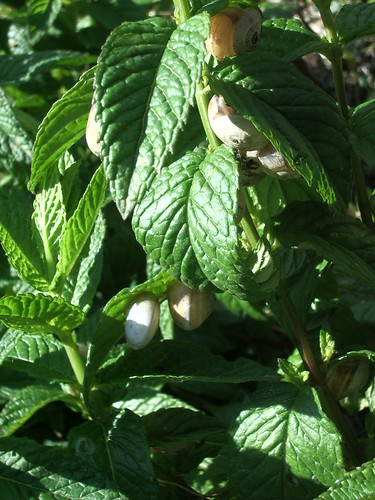
My evening of snail collecting yielded only eight snails.
It was still too warm outside but I wasn't about to wander around the garden in the dark with a flashlight. I probably would have stepped on more than I collected!

I'll give them fresh fennel fronds and parsley later today and keep them away from our cat. She's freaked out by them!

Happy Easter (Easter Sunday)


The French Easter tradition brings chocolate, lots of chocolate to every home! And it comes in all shapes, although my all time favorite is the Easter Egg. You find chocolate Easter Bunnies, and the classic Chocolate Bells that, traditionally, bring the Easter eggs.
Easter Sunday is a happy time for young French children as they are told that the bells have come while they sleep and have hid eggs that they have to find. In the catholic tradition, the bells go silent on the Thursday before Easter, and ring again on Sunday to mark the resurrection of Christ.
When my girls were little, decorating egg shells with many colors was a typical activity during the season.
Every year, I buy a large Easter Egg for each one of them, and one that I share with my husband. This year, I am trying a new Chocolatier on rue d'Auteuil, Les Grillons. I bought one dark chocolate, one milk chocolate, and one marble type white/milk/dark chocolate. Eggs come with lots of small eggs inside.
Joyeuses Paques!

Photo du Jour - Turning


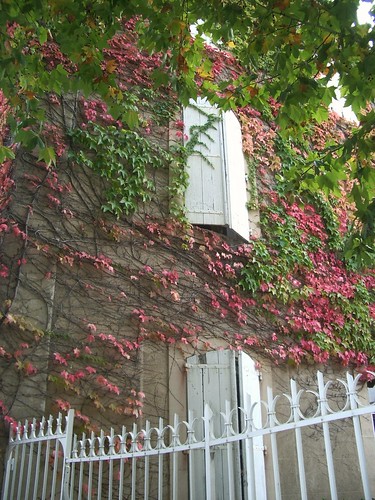
The leaves continue to turn.

Still hungry?


READ MORE
Over at the Dannon Kitchen is my current post and recipe for a Banana Nut Smoothie which was inspired by the flavors of banana bread.


With any luck I'll have a banana bread recipe here tomorrow!

Banana Leaf Coconut Fish:Recipe


What's a beautiful shade of green, used in Asian, Latin American, Caribbean and African cooking, but completely inedible? Banana leaves! Banana leaves grow in tropical climates, and are used to steam, grill, serve and store food. In Thailand they are used just like tin foil and about as frequently. Banana leaves are used when they are still fresh and green, as a result, there is a very moist quality to any food cooked in them.

While not grown commercially in the US, banana leaves are worth seeking out because they lend a delicious herbal flavor to food when cooked. They can be used for slow moist cooking of tough meats or even tamales, and for quicker grilling, baking or steaming of more delicate ingredients like fish or chicken. You can cook several servings in a large banana leaf or cut the leaf into individual serving pieces. Steaming or baking individual servings "en papillote" is not only elegant, but generally makes clean up a breeze. The scent of the steam when the banana leaves are unwrapped is truly lovely.

This is a recipe I developed using several aromatic Asian ingredients. It has no chilies so it is particularly mild; though if you want to add chilies or other aromatics like lemongrass I suppose you could. I love using exotic ingredients like banana leaves, and when they only cost 79 cents a package, so much the better. Look for banana leaves in Asian or Latin grocery stores in the freezer section and if you find them, give them a try. (if you can't find banana leaves, you can almost always substitute tin foil or parchment paper) The foil is just used in this recipe to more easily seal the banana leaf packet.

Banana Leaf Coconut Fish
2-3 servings

1 lb firm white fish (sea bass is good)

2 cloves garlic, chopped
1 Tablespoon ginger peeled and chopped
1/4 cup packed chopped cilantro leaves
2-3 Tablespoons coconut milk
2 teaspoons soy sauce
1 teaspoon fish sauce
1 teaspoon brown sugar, packed

Preheat oven to 425 degrees. Mix all the ingredients together in a bowl and add the fish cut into 4-6 serving size pieces about 1 inch thick. Let sit for 20 minutes.

Run the banana leaf under hot water until defrosted and pliable. Cover a baking sheet in tin foil, then lay a banana leaf or pieces of banana leaf, double the size of the fish, on top of the foil. Place the fish on the leaf or leaves and make sure all the sauce and herbs are put onto the fish. Wrap the banana leaf (leaves) around the fish and use the foil underneath to secure the banana leaf. Bake on the baking sheet for 20-25 minutes or until done. Serve with rice.

Enjoy!

Photos du Jour - Mint


There's a huge patch of mint growing in the garden...


...and it is extra crunchy!