Veal Stew


Sometimes, grocery shopping in New York can be a real chore.  At first, I hated it.  Sacrilege, I know, but before you throw something, hear my out.  In New York, before you get a feel for what's out there, one-stop shopping can be virtually nonexistent.  "You have bread flour but not yeast? Okay, I'll go somewhere else.  But I'd better haul that bread flour with me, because there's no guarantee they'll have it at the next store..."  Going to three different places to find a grapefruit is par for the course.  And although this doesn't sound like a big deal, I don't have a car here in the city.  So there's no throwing groceries in the back seat and stopping off at the next place.  No, I have to walk.  And carry.  And carry on the subway.  Sometimes I even work up a sweat, which I do NOT admit to lightly.


But after a few years (yes years) of keeping mental notes whenever I went shopping as to where I could get what, I have a pretty good feel for the layout.  And now I revel in everything I have access to in "The City."  I've been collecting ingredients for this particular recipe for about a week and a half.  The quince from the farmers market, the limou-omani and the advieh from Tashjian Karnig in Murray Hill and the veal cubes from Gourmet Garage on the Upper, Upper East Side.  Normally I make do with substitutions if something alludes me, but for some reason I made up my mind to really follow this recipe.  Okay, not true.  The recipe originally called for lamb, but made an allowance for veal.  I don't care, I checked, and I've made no mental notes for lamb.  (By the way, isn't it strange when people fact-check themselves when writing instead of just deleting the lie and starting over with the truth?)

In this case, shopping was something like a scavenger hunt, and one of the best things to come out of this recipe, other than a great big pot of deliciousness, was definitely Tashjian Karnig (Lex between 28th and 29th for those of you in NYC).  It is a revelation and my new favorite place.  Sometimes heading into an ethnic market can be intimidating, and in New York it's like stepping into another world, usually complete with a foreign language, and if you're paranoid, people wondering what that incompetent white girl is doing bumbling around in here.  But I was too overwhelmed to be shy and just walked in circles around, and around the teeny store overflowing with all things Middle Eastern.  Besides, since I had specific things to look for, it was very easy to appear occupied.


As far as these ingredients go, limou-omani are dried Persian limes, and look like fluted, walnut-sized orbs.  The recipe calls for 1 teaspoon of the ground powder, but since all I could find were the actual dried fruits, I ground them myself in my handy little mini-food processor.  If you can't find any, I'd just substitute some fresh lime juice to taste.  You'll be replacing the deep flavor of the dried limes with a brighter twist, but it will still be good.  Advieh is a kind of Iranian all-purpose seasoning, based on cinnamon, cardamom, turmeric and dried rose petals (!!), among other things. (I'd tell you what those other things are, if I knew.  I think you have to be initiated for that, though.) 


The recipe comes from Najmieh Batmanglij's Food of Life (the older version, there's also an expanded New Food of Life out that gets excellent reviews, but this is the version I have).  I made a few adjustments to the original recipe, and my version is what you find bellow.  Nothing major, and it still turned out, well, wonderful!  

When skimming the recipe, if you notice the prunes and think "ewww" please please please reconsider and don't leave them out.  The slow stew turns them into delectable and deeply flavored little balloons of goodness that burst on the tongue.  If calling them "dried plums" helps, do that.  Also, I drained my eggplant before adding it, although the recipe doesn't call for this step and thinking back now, it's probably extraneous since they're being cooked for so long with so many other things.  And if you can't find quinces, replace them with apples.  You don't need to peel the quince, but be sure to wash them, especially if they're charmingly fuzzy.

Veal Stew

3 large onions, sliced
1.5 pounds veal, sliced into stewing cubes 
2 garlic cloves, passed through a press
2 small quinces, cored (peeling not necessary)
1 small eggplant, peeled and sliced
2 carrots, peeled and sliced
3 tomatoes, sliced (peeling not really necessary)
2 large potatoes, peeled and, sliced
4 tablespoons oil
1 cup pitted prunes 
1 teaspoon advieh
1/4 teaspoon turmeric
2 teaspoons salt
1/4 teaspoon pepper
1 tablespoon tomato paste dissolved in 2 tablespoons hot water
1/4 teaspoon saffron, ground and dissolved in 1 tablespoon hot water
1 tablespoon powdered limou-omani 

Pour 2 tablespoons oil into a large, heavy Dutch oven.  Layer the first 8 ingredients in the pot in the order they're listed.  Top with the prunes, then pour in the remaining oil.  Sprinkle the advieh on top, as well as the turmeric, salt, pepper, dissolved tomato paste, saffron and limou-omani.  Cover and cook for 2 hours on low heat.  After 2 hours, remove the lid and mix the contents around a little.  The veggies will have released their juices forming a succulent broth.  Bring the broth to a gentle simmer, re-cover and continue to cook until done, around another 1.5 hours.  Serve and enjoy! 

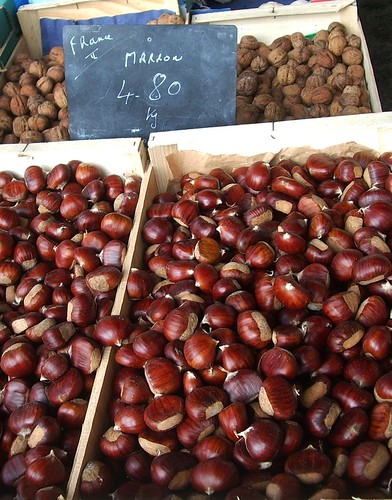
Photo du Jour - les Marrons


Les Marrons made their first appearance at the market this week.

Now I'm craving Pumpkin and Chestnut Soup.

La Couleur Blanche

Paris

Cassis

Fromage de Chèvre


Along the Canal du Midi

Wrought Iron Balconies

Café

Windowbox

In the Louvre

Spring!

Café Chairs

snow on the vines

Brie de Melun

Abandoned

Marseille

Light, pale, crisp and clean, white can sometimes be overlooked as a color.  But those luminous hues and alabaster shades are beautiful in their own right.  We just need to notice them.

Looking for a splash of something brighter? 
Here are some blues and reds and greens
Or maybe you prefer purple

Roast Lamb w/ Figs


Ohh figs.  How to describe this marvelous fruit that is just as interesting in flavor as it is in shape and color?  They are wonderful plain, but I decided to change things up a bit and make a sauce with them, to serve over some well-cooked lamb chops. 

The sweet and rich taste combined with the silky texture of this sauce pair beautifully with heavier cuts of meat, which is why I chose to serve it with roast lamb. And although this dish may seem very substantial, it was actually pretty light - my dining partner and I cleaned our plates, and still had room for dessert! This sauce can also be eaten with so many other things - on a crostini with feta or goat cheese, in a turkey sandwich, on vanilla ice cream - the possibilities are endless, and I invite you to explore! I served it with an endive and toasted walnut salad (recipe is on my blog), but I imagine that any green salad would go nicely. One final note: if you would like to make this when figs are out of season, substitute 8 dried mission figs for the fresh ones.

Roast Lamb w/ Figs - serves 1


For the lamb chops:
2 tablespoons chopped parsley
1 tsp chopped thyme
1 tsp chopped sage
1 tsp chopped rosemary
1 tsp fresh ground pepper
1 tbsp olive oil
3 1-inch thick lamb chops

For the fig sauce:
4 very ripe fresh figs, stemmed and quartered
3/4 cups port wine
2 teaspoons chopped rosemary
2 teaspoons chopped thyme
1 pinch salt
1 pinch pepper


1. Wash and pat the lamb chops dry, and rub with salt.
2.  Mix the herbs and pepper for the lamb together with 1 tbsp. olive oil in a small bowl; spread 1/2 of the mixture over all of the lamb chops. Place the chops in the fridge to marinate for at least one hour (this can be done 1 day ahead - let the chops marinate overnight, and store remaining herb mixture in fridge).
3.  Place all fig ingredients in a small saucepan; bring to a boil and simmer, uncovered, until port has reduced to a syrupy glaze, about 35-40 minutes.
4.  Preheat the oven to 350 degrees.
5.  Meanwhile, heat 1 tablespoon olive oil in a large skillet over medium-high heat. Arrange chops in skillet and try not to crowd the pan. Cook them until browned, about 3-4 minutes per side.
6.  Place lamb chops on a lined baking sheet; spread remaining herbs over them. Scrape up any browned bits from the skillet and sprinkle over the lamb chops.
7.  Roast the chops until just cooked through and no very pink parts remain, about 20 minutes. (This part is very personal - if you like your lamb chops rare, you may want to cook them for less time. In any case, I would suggest taking the chops out and cutting one open with a fork and knife to check for doneness, and cook for longer if necessary).
8.  Spoon the fig sauce on two individual plates. Lay the chops on top, and serve. Enjoy!! I recommend having some bread handy to soak up any leftover sauce.

The ABCs of Everyday French Cuisine 3: C for carottes


(Flickr photo courtesy of Maxime LeDuc)

Carrots are a reliable vegetable. They keep well, are easy to cut up and please everybody in my family. I virtually always have them on hand and, as in American cooking, they are one of the staple vegetables of everyday French cuisine.

When I was a student in Tours in the 1980s, we frequently ate at a restaurant that served plain, home-style French food. We had a food allowance and could just afford the three-course evening meal, which, if my memory serves me correctly, cost 5 francs. (Is this possible?) One of their recurring starters was carottes râpées, and my fellow students and I all felt these grated carrots with a simple vinaigrette were somehow extraordinary.

I suppose I have become blasé, but plain grated carrots with vinaigrette rather bore me now. I usually perk up the salad with another fruit or vegetable, especially apples and/or zucchini. Sometimes I add a lot of herbs, especially coriander when I have it, or make some fancy sauce with yogurt or orange juice. I'm not sure how French all of this is, but variety is the spice of cooking life. And speaking of spices, cumin is pretty delicious with grated carrots.

One supermarket item that saddens me is ready-made carottes râpées. They just seem like a very depressing thing to buy:


In France, raw carrots are generally eaten in this grated form. When I serve carrot sticks with a dip, whether to my family or friends, the former wolf them down and the latter consider the presentation original and exotic.

Carrots enter into many other French recipes, of course. They are a frequent ingredient in traditional French blended soup, and carottes Vichy, originally made with Vichy mineral water, are a well-known French classic.

Personally, I often toss carrots in with a roasted chicken, include them in about every mixed vegetable dish I make, and occasionally concoct something elegant from them, such as this carrot flan:


However, unlike many of my American expat friends, I have never attempted to make a carrot cake in my French kitchen. But I think if I wanted to get comments about "original" and "exotic" cooking, that would definitely beat carrot sticks!

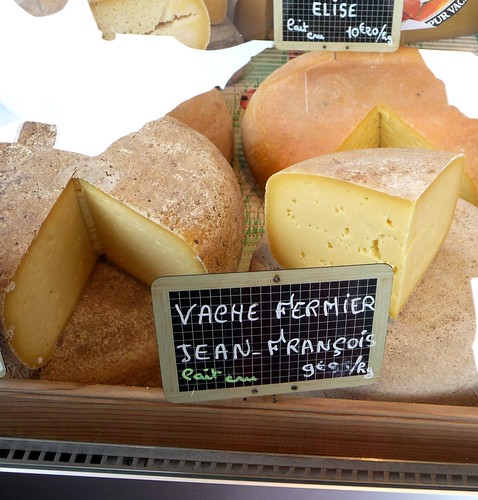
La Fête du Fromage - Vache Férmier de Jean-François

The little car hurtled across the lush Gascon countryside and deep down into Armagnac country where it finally came to a halt in the market town of Eauze, our destination. Our plans for the day were simple: pick up a few fresh vegetables and some other treats at the market for dinner, then have a bite of lunch before an afternoon of Armagnac tasting. If only every day were like this one!

Kate also wanted me to meet a special fromager at the market whom she is friendly with.
What makes him special is that he hand picks and sells the cheese from a few select producers based in the Béarn area of the Pyrénées. As the cheeses are all produced by artisans or on small farms, they are given the names of their producers.

Let me introduce you to Vache Férmier de Jean-François.


This is a typical, rich and buttery unpasteurized mountain cheese. The flavor of sweet grasses softly perfume the pâte and the lovely nutty flavor is really delicious. I noticed a mild saltiness and the texture is supple and chewy. All around a very enjoyable fromage férmier. Jean-Françios should be very proud of his creation.
And for the price of only €9.95 a kilo, this cheese is a bargain!

We opened a bottle of 100% old vine carignan and found it to be a superb wine pairing.


Williams-Sonoma Tools & Techniques

Williams-Sonoma Tools & Techniques


The sense of joy and satisfaction that I get from cooking something wonderful and sharing it or eating it is almost indescribable. Not only do I feel pride, but it inspires me to take on more and more recipes and techniques. I learned to cook from watching my parents, reading cookbooks and watching television cooking shows. But it took years and years and there is still more for me to learn.

Over the years I have upgraded and accumulated various tools. Whether it's the pleasure of using a favorite chef's knife, or finding the ultimate digital remote probe thermometer I think if you enjoy cooking, you can't help but be a bit of a kitchen gadget geek.

When I was first learning to cook I loved the Jacques Pepin La Technique book. There were plenty of techniques I wouldn't try for years and even more I still haven't tackled, but in that book with all of those photos I gained immeasurable confidence. Truth be told, most of those very French techniques are not ones I use day-to-day. For a book that combines the meticulous instructions you find in La Technique, but more basic everyday techniques and great color photos every step of the way, the new Williams-Sonoma Tools & Techniques book is truly masterful and a terrific resource. It's a book I wish I had owned way back when I was just learning to cook.

The upfront section, after a forward by Thomas Keller and introduction by Chuck Williams, goes into great detail about the essential kitchen tools. These are not Williams-Sonoma branded items, but the basics and beyond such as Pyrex measuring cups, earthenware tagines, silicone spatulas--oh don't get me started! I'll turn into a kitchen nerd before your very eyes.

The techniques section shows everything from separating eggs to cleaning a whole fish and carving a turkey to embellishing pies and how to make meringue, something one day, I hope to conquer. There are plenty of recipes in this book for things like fish fumet, braised vegetables, pasta dough and buttermilk fried chicken, but it's really all in the service of learning how to cook. I can't think of a better book for a newlywed or a singleton, anyone really who wants to learn the basics the right way. Kudos to the team who spent 3 years creating this amazing volume and especially to Jen Newens the executive editor.