A Muscat grape vine growing on our friend's house.
Best Burger Contest
I love a good burger, but I don't eat them all that often. I'd say I go out for a burger two or three times a year and when I do I'm very particular. All the fixings have to be perfect. I want the meat freshly ground and chargrilled, and the lettuce crispy, the tomato ripe, the onion sweet and the bun slightly toasted and impeccably fresh, the accompanying fries, extra crispy, otherwise, why bother?
So when I got an offer to try some grass-fed beef I decided to conduct a burger taste test. With all the fuss over designations like natural, organic, humane, terroir, and dry-aged, I figured I'd compare a few and see for myself. After all, the fixings are easy to handle at home, it's the freshly ground, great tasting beef that's the challenge.
Many people have sworn off beef. First it was due to high cholesterol and then mad cow disease. But if like me, you're going to eat beef, it's important to note that grass fed beef is considerably healthier than grain-fed beef. Grass-fed cows never eat animal by-products, which is the main cause of transmission of BSE (mad cow disease). It's lower in fat and calories than grain-fed beef. And some research indicates that the mixture of fats in grass-fed beef which compared to grain-fed beef is higher in Omega-3 oils, has more conjugated linoleic acid and has a higher concentration of unsaturated fats versus saturated fats may actually lower cholesterol.
So how did they stack up?
For the purpose of the test I tried only 85% lean grass-fed beef burgers.
Technique:
Each of the previously frozen six ounce patties were allowed to come to room temperature for 30 minutes. They were salted 15 minutes before cooking. They were cooked in very hot cast iron pans for 4 minutes on one side and for 2 minutes on the second side, then allowed to rest for five minutes.
The contenders:
Prather Ranch Meat Company
Back Angus, Hereford, and Black Baldie cows from California
Grass-fed
Finished with rice bran and barley
Certified organic
Certified humane
Dry-aged two - three weeks
Western Grasslands
Black Angus and Hereford cows from California
Grass-fed
Finished with rice bran and almond hulls (I think)
Organic-pending certification
Humane
Dry-aged? (my attempts to contact the company went unanswered)
La Cense Beef
Black Angus cows from Montana
Grass-fed
Grass finished
Pesticide-free, not organic
Dry-aged 19 days
Cost:
Prather Ranch
$5.99/lb direct from Prather Ranch Meat Company at the Ferry Plaza Market
Western Grasslands
$6.99/lb at Whole Foods
La Cense
$7.06/lb available online
Appearance:
Prather Ranch
Light red when raw, light to medium brown when cooked
Western Grasslands
Medium red when raw, medium brown when cooked
La Cense
Very dark red when raw, darker brown when cooked
Taste:
Prather Ranch
Juiciest, intense flavor, delicate texture, fattiest, Amy's favorite
Western Grasslands
Tender, yet with a little chewiness, mildly beefy, lean
La Cense
Driest, milder flavor, very lean, firmer patty, more traditional flavor, Lee's favorite
Results:
All three were very tasty and well worth seeking out if you want to make a high quality burger at home. Even though I couldn't chargrill mine and I had to suffer a serious lack of fries. But taste differences were noticeable and there was no one clear winner. Many things can account for differences in taste, including the time of year and the quality of the grass the animal eats. Try and see what you like.
The differences in cost were not great, check and see what options there are near you. Being able able to purchase a product that is certified organic and humane is something that may also influence your decision. To find certified humane raised and handled products at a store near you, visit the Certified Humane website and be sure to check the product list.
FOOD + BEEF
Pasta, no pomodoro
At the risk of sounding as though we’re carb-loading over here—which, actually, now that I’ve typed that, sounds like a pretty tasty thing to do—I present you with my second pasta dish in as many posts. I’m having a hot summer fling with Italy, but luckily, Brandon doesn’t seem to mind. In fact, I think he’s happy about it. You will be too, when you taste this.The dish in question comes not from
Sunday Lunch in the Haut Languedoc
The unseasonable cold and impressive gusts of wind blowing through the Haut Languedoc meant that lunch on the terrace was impossible.
No matter.
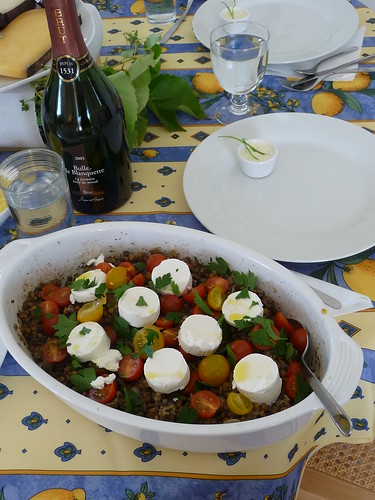
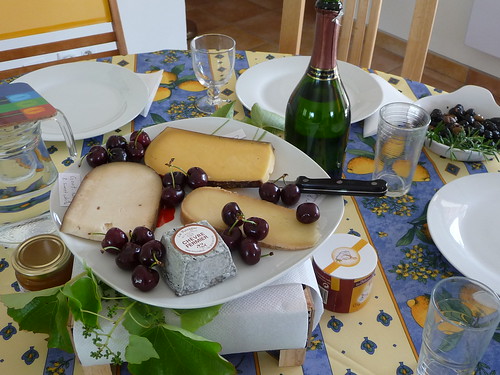
Our friends prepared a gorgeous summery feast today that made us forget all about the weather. Homemade aïoli, local smoked trout, earthy lentil salad, wine from a co-op in a neighboring village and a cheese course from heaven.
What a perfect day.
Heirloom Norwegian Apple Cake and a Story in Kamille
This is R's mother's recipe for Norwegian Apple Cake. I made it all the way back in October for what I think is a pretty rad reason. If you've been reading here for any length of time, you've probably noticed that I make quite a bit of Norwegian food, and evidently a journalist in Norway noticed too. So on a trip to New York, she stopped by my little East Harlem apartment with a real photographer and interviewed me for a story about this blog and about my interest in Norwegian food for Kamille, one of Norway's largest woman's magazines. If you're in Norway, you can find the issue in stores now, if my family-in-law hasn't already stock-piled all of them. If you've found me through Kamille, welcome! You already know that I'm married to a Norwegian, but living in New York City where I often attempt to recreate the cuisine of his native country in a tiny apartment kitchen.
The whole interview experience was really wonderful. We sat in my living room, which doubles as the family room, the dining room and the study, ate Norwegian Apple Cake and talked about food, about cooking in New York, and about exploring Scandinavian cuisine. Then we took a little walk around the neighborhood, pausing at some of the beautiful brownstones around the block and popping into what we affectionately call 'the fruit stand.' It's actually a little Turkish shop down the street that overflows with produce, woven and wicker baskets hanging from the ceiling, and baklava and Turkish delight to tempt you at checkout.
And speaking of the Apple Cake. I'll admit I spent several days deciding what to serve, looking through cookbooks and grilling R. But when it came down to it, as much as I love my books, nothing ever really beats a family recipe. R says that every family has their Apple Cake in Norway, and I've been trying a lot of them. But this one was definitely the best. It's the one R grew up eating, his mother's recipe. And like all great classic European cakes, it's not at all difficult to make. Tusen takk Kamille!
My Family's Norwegian Apple Cake
Family Recipe
200 grams unsalted butter, at room temperature
200 grams sugar
3 large eggs
200 grams flour
1/2 teaspoon vanilla sugar
1 teaspoon baking powder
Sugar, cinnamon and chopped or slivered almonds for topping.
2 or 3 apples, depending on size, cut into wedges. You want enough wedges to make one layer in an 9 inch pan.
Oven preheated to 175C or 350F
Cream the butter and sugar together until pale in color. Add one egg at a time and mix well between each egg. Add the flour and the vanilla sugar. Put enough of the batter into a 9 inch springform pan so that it about 1 inch deep. You can really use any springform pan, but you might need to adjust the cooking time.
Place a layer of apple wedges on top of the batter, then sprinkle with the chopped almonds, some cinnamon and some sugar. Using a spoon dipped in warm water, place dollops of the remaining batter on top of the apple layer. You don't want the dollops so close together that they seal in the apples, because steam needs to escape as it bakes.
Bake in the center of the oven for 45 minutes to 1 hour, or until the edges of the cake start to peel away from the pan.
Revue de presse cuilinaire 3: January 2006

The Prisma Presse group publishes three cooking magazines: Guide Cuisine, Cuisine Actuelle and Cuisine Gourmande. The latter is the most upscale title of the trio, and focuses more on dinner invitations, decoration and creative cooking. Sometimes their creativity goes a bit overboard, as in the recipe for Brownies de betterave (Beet Brownies) found in the January-February 2006 issue. I'm all for finding more imaginative ways to use beets, but I'm not sure including them in brownies is one of them. Besides the beet feature, the January Cuisine Gourmande presents ideas for celebrating Chinese New Year and for using cinnamon, which is relatively rare in French cooking. The cover story announces the "eternal comeback" of bistro cooking, and the magazine leads off with "La recette dont on parle," or the recipe that everyone is talking about: Compote de cranberries et crème coco, or Cranberry and Coconut Cream Compote.
Prelude to a lamb roast, or why it is good to know the Knights
My leisure sports need work. My pool game is almost as bad as my bowling, which is bad. But, on the upside, I am uncannily good at rolling around on the pool table like Tawny Kitaen on the hood of the Jaguar in that old Whitesnake video. I also know all the lyrics to Dolly Parton’s “Nine to Five” and Kenny Rogers’ “The Gambler,” which scored me big Brownie points last night with Keaton’s
Subscribe to:
Comments (Atom)